Solutions Volume 9: Symbolic Logic
Lesson on Sentences and Negation
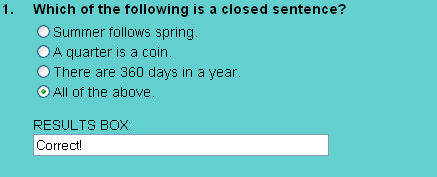
Each of these sentences is a closed sentence (an objective statement which is either true or false).
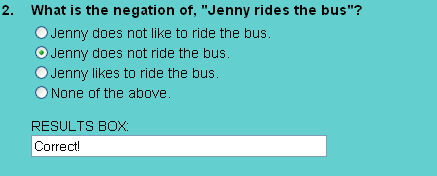
“Jenny does not ride the bus” is the negation of “Jenny rides the bus.” The negation of p is “not p.”
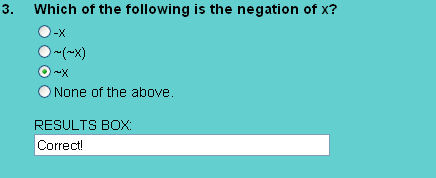
The statement ~x represents the negation of x.
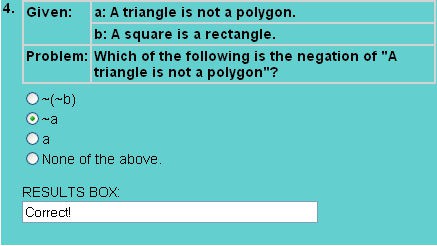
The statement ~a represents the negation of a.
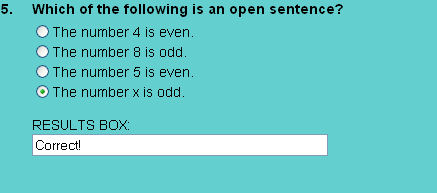
Choice 4 has a variable in it. An open sentence is a statement which contains a variable and becomes either true or false depending on the value that replaces the variable.
Lesson on Conjunction
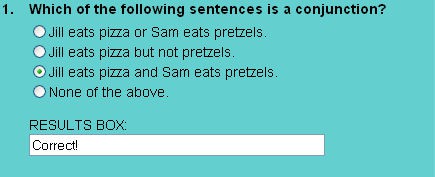
“Jill eats pizza and Sam eats pretzels” is a conjunction. A conjunction is a compound statement formed by joining two statements with the connector AND.
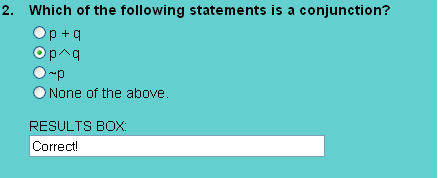
The conjunction “p and q” is symbolized by p q.
q.
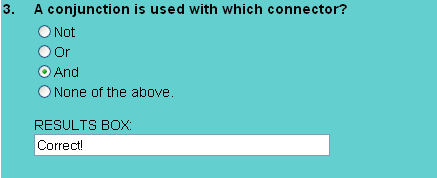
A conjunction is a compound statement formed by joining two statements with the connector AND.
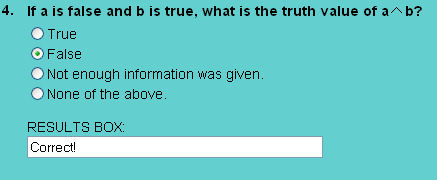
The truth value of ab is false. A conjunction is true when both of its combined parts are true, otherwise it is false.
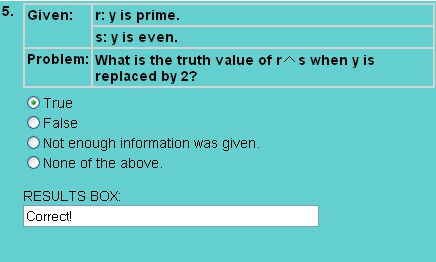
When y = 2, the statement r is true and the statement s is true (i.e., The number 2 is both prime and even). Therefore, the conjunction rs is true when y = 2.
Lesson on Disjunction
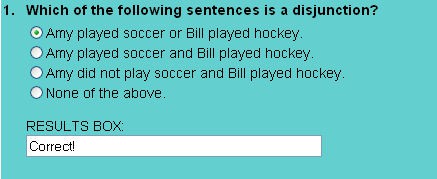
A disjunction is a compound statement formed by joining two statements with the connector OR.
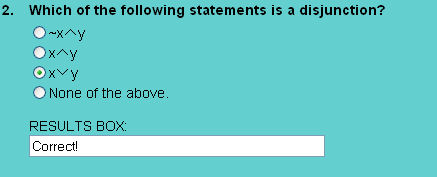
The statement x y is a disjunction.
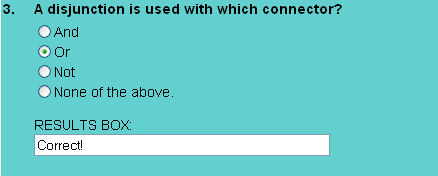
A disjunction is a compound statement formed by joining two statements with the connector OR.
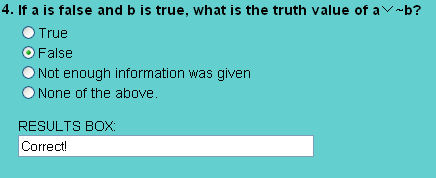
If b is true then ~b is false. A disjunction is false when both statements are false. Therefore, the disjunction a~b is false.
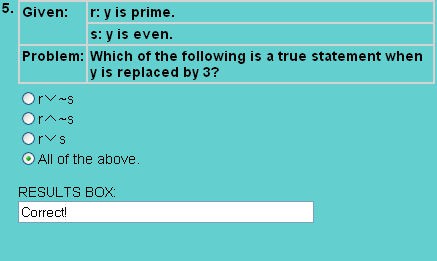
When y = 3, the statement r is true and the statement s is false. Therefore, all three choices list true statements.
Lesson on Conditional Statements
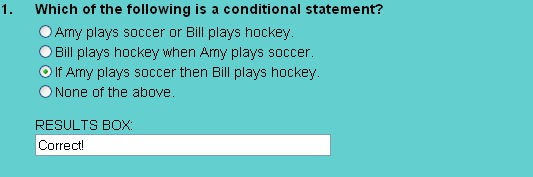
A conditional statement is an if-then statement in which p is a hypothesis and q is a conclusion.
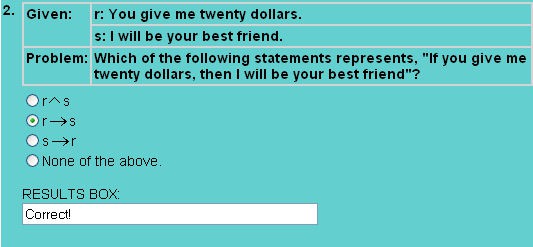
The hypothesis is r and the conclusion is s. The logical connector in a conditional statement is denoted by the symbol  .
.
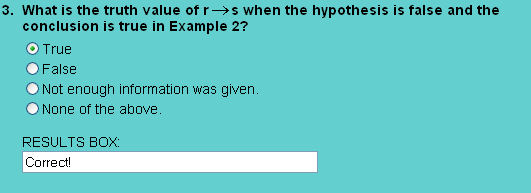
The conditional is defined to be true unless a true hypothesis leads to a false conclusion.
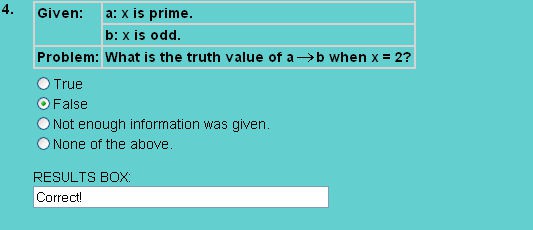
When x=2, hypothesis a is true and conclusion b is false. When a true hypothesis leads to a false conclusion, the conditional is false. Thus when x=2, conditional ab is false.
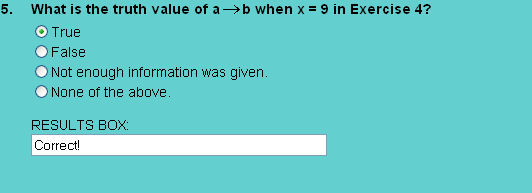
When x=9, hypothesis a is false and conclusion b is true. By definition, conditional ab is true.
Lesson on Compound Statements
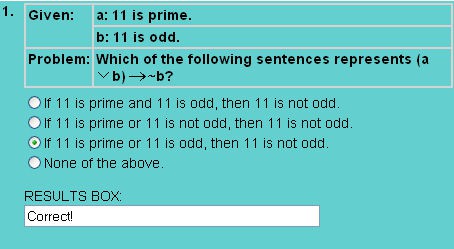
The compound statement (ab)~b is a conditional, where the hypothesis is the disjunction “a or b” and the conclusion is ~b.
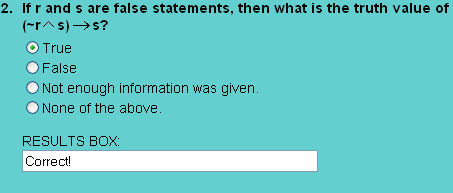
If r and s are false statements, then (~rs)s is true as shown in the truth table below.
| r | s | ~r | ~rs |
(~rs)s |
| F | F | T | F | T |
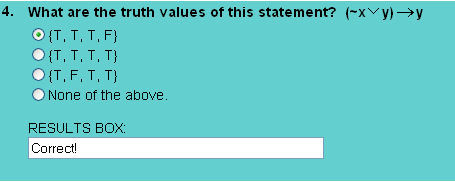
The truth values of (~xy)y are shown in the truth table below.
| x | y | ~x | ~xy |
(~xy)y |
| T | T | F | T | T |
| T | F | F | F | T |
| F | T | T | T | T |
| F | F | T | T | F |
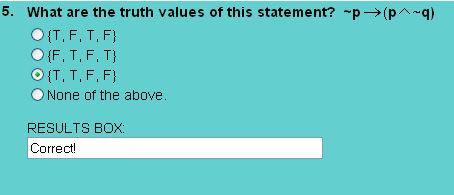
The truth values of ~p(p~q) are {T, T, F, F},
as shown in the truth table below.
| p | q | ~p | ~q | p~q |
~p(p~q) |
| T | T | F | F | F | T |
| T | F | F | T | T | T |
| F | T | T | F | F | F |
| F | F | T | T | F | F |
Lesson on Biconditional Statements
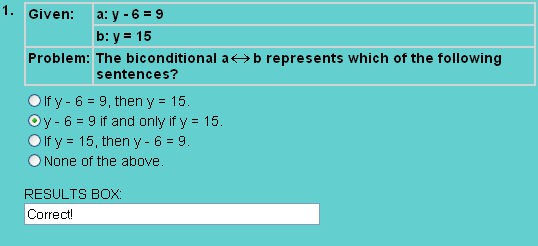
Biconditional p q represents “p if and only if q,” where p is a hypothesis and q is a conclusion.
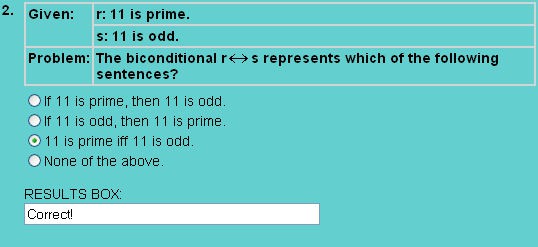
The hypothesis is “11 is prime” and the conclusion is “11 is odd”. So rs represents, “11 is prime if and only 11 is odd.” The “if and only if” is abbreviated with “iff” in choice 3.
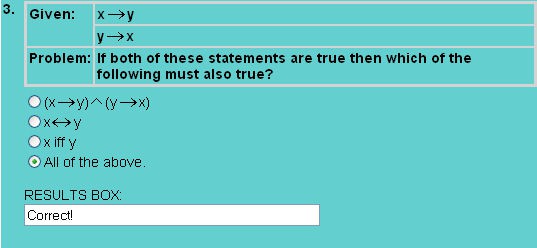
When proving the statement p iff q, it is equivalent to proving both of the statements “if p, then q” and “if q, then p”. Since these conditionals were given in the problem, xy is biconditional. Therefore, each statement listed in choice 1, 2 and 3 is true.
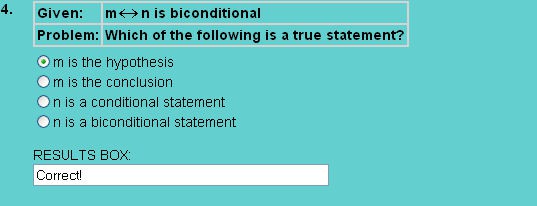
The biconditional pq represents “p if and only if q”, where p is a hypothesis and q is a conclusion. So m is the hypothesis of mn.
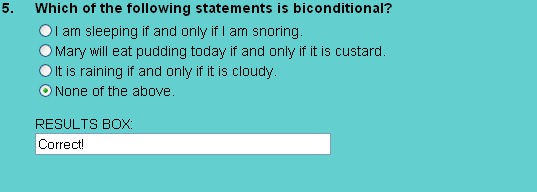
None of these statements is biconditional: one can sleep without snoring; Mary can eat pudding today that is not custard; it can be cloudy without any rain.
Lesson on Tautologies
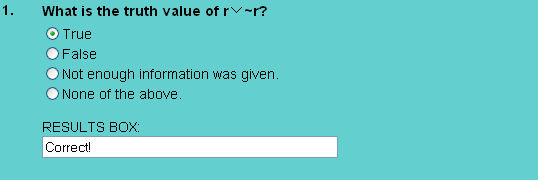
A compound statement, that is always true regardless of the truth value of the individual statements, is defined to be a tautology. The disjunction of a statement and its negation is a tautology.
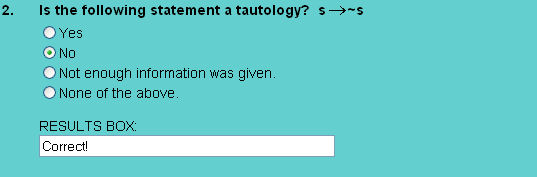
No, the conditional statement s~s is not a tautology. See the truth table below.
| s | ~s | s~s |
| T | F | F |
| F | T | T |
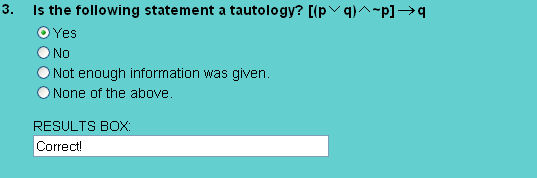
Yes, the statement [(pq)~p]q
is a tautology since its truth values are {T, T, T, T} as shown in the truth table below.
| p | q | ~p | pq |
(pq)~p |
[(pq)~p]q |
| T | T | F | T | F | T |
| T | F | F | T | F | T |
| F | T | T | T | T | T |
| F | F | T | F | F | T |
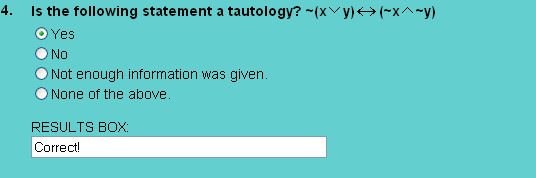
Yes, the statement ~(xy)(~x~y) is a tautology since its truth values are {T, T, T, T} as shown in the truth table below.
| x | y | ~x | ~y | xy |
~(xy) |
~x~y |
~(xy)(~x~y) |
| T | T | F | F | T | F | F | T |
| T | F | F | T | T | F | F | T |
| F | T | T | F | T | F | F | T |
| F | F | T | T | F | T | T | T |
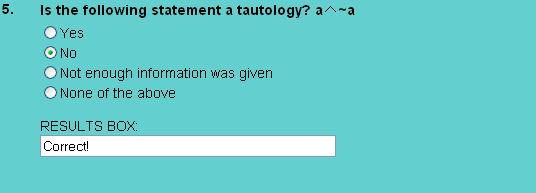
A conjunction is true when both parts are true. Since a statement and its negation have opposite truth values, the conjunction of a statement and its negation could never be true.
Lesson on Equivalence
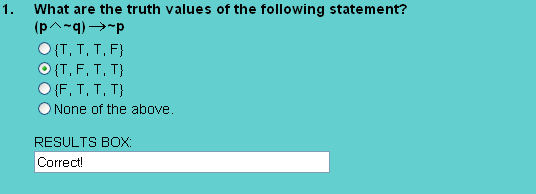
The truth values of (p~q)~p are {T, F, T, T} as shown in the truth table below.
| p | q | ~p | ~q | p~q |
(p~q)~p |
| T | T | F | F | F | T |
| T | F | F | T | T | F |
| F | T | T | F | F | T |
| F | F | T | T | F | T |
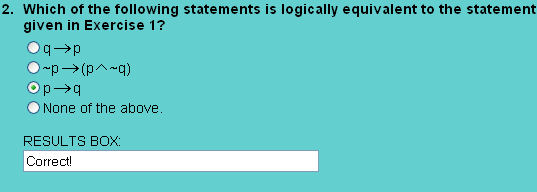
The statement pq is logically equivalent to the statement (p~q)~p, since they both have the same truth values, as shown in the truth table below.
| p | q | pq |
(p~q)~p |
| T | T | T | T |
| T | F | F | F |
| F | T | T | T |
| F | F | T | T |
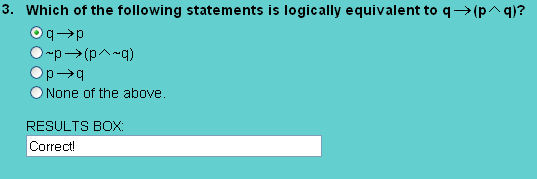
The statement qp is logically equivalent to the statement q(pq) since they both have the same truth values, as shown in the truth table below.
| p | q | pq |
q(pq) |
qp |
| T | T | T | T | T |
| T | F | F | T | T |
| F | T | F | F | F |
| F | F | F | T | T |
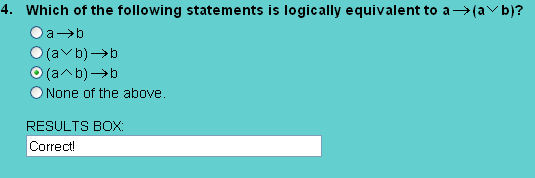
The statement (ab)b is logically equivalent to the statement a(ab) since they both have the same truth values, as shown in the truth table below.
| a | b | ab |
ab |
(ab)b |
a(ab) |
| T | T | T | T | T | T |
| T | F | T | F | T | T |
| F | T | T | F | T | T |
| F | F | F | F | T | T |
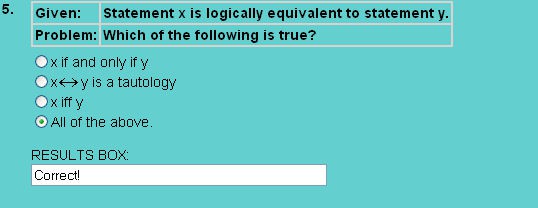
Equivalent statements have the same truth values. Therefore, x and y satisfy the definition of a biconditional.. Thus, the statements listed in choice 1 and choice 3 are true. The biconditional of two equivalent statements is a tautology. Therefore, the statement listed in choice 2 is true.
Practice Exercises
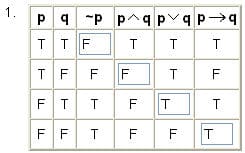
This truth table shows the truth values for the negation of p, and for the conjunction, disjunction and conditional of statements p and q.
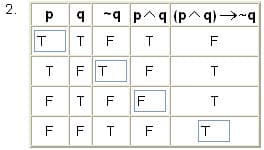
This truth table shows the truth values for the compound statement (pq)~q.
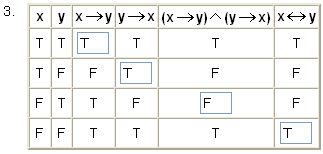
This truth table shows the truth values of various compound statements involving x and y.
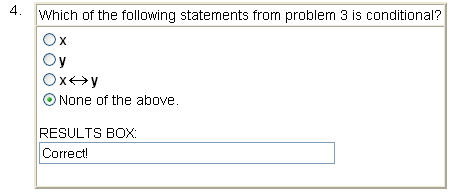
The conditional statements in problem 3 are xy and yx.
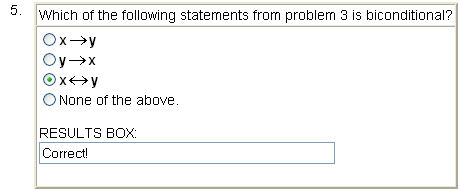
The biconditional statement from problem 3 is xy.
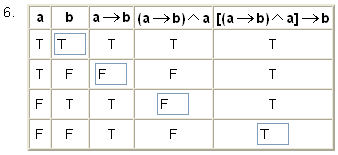
This truth table shows the truth values of various compound statements involving a and b.
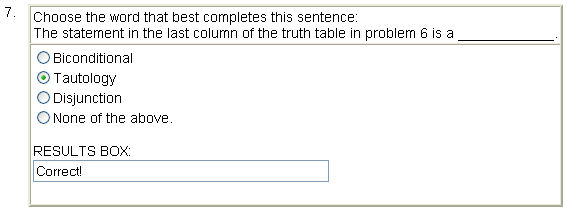
The statement in the last column of the truth table in problem 6 is a tautology since all of its truth values are true.
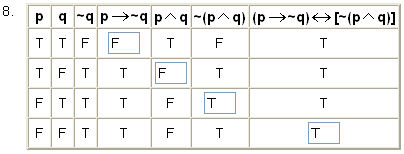
The truth values for the last column are all true. Thus the statement (p~q)[~(pq)] is a tautology.
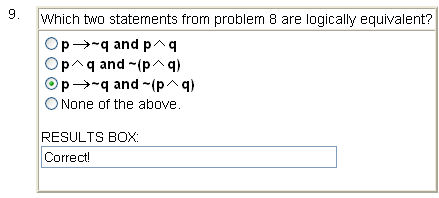
The statements p~q and ~(pq) have the same truth value. These statements are, therefore, logically equivalent.
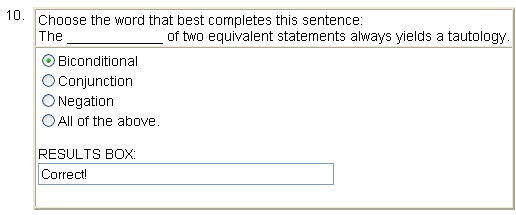
The biconditional of two equivalent statements is a tautology.
Challenge Exercises
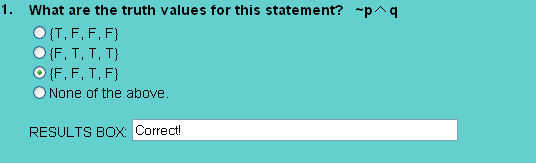
See the truth table below.
| p | q | ~p | ~pq |
| T | T | F | F |
| T | F | F | F |
| F | T | T | T |
| F | F | T | F |
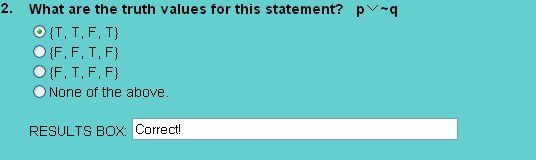
See the truth table below.
| p | q | ~q | p~q |
| T | T | F | T |
| T | F | T | T |
| F | T | F | F |
| F | F | T | T |
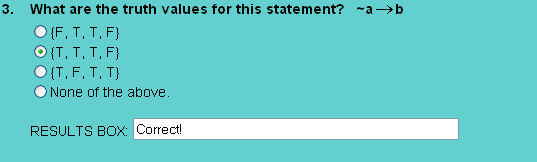
See the truth table below.
| a | b | ~a | ~ab |
| T | T | F | T |
| T | F | F | T |
| F | T | T | T |
| F | F | T | F |
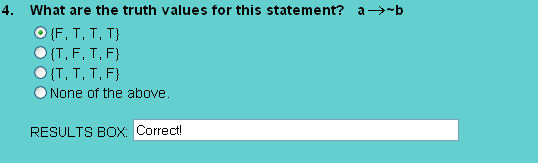
See the truth table below.
| a | b | ~b | a~b |
| T | T | F | F |
| T | F | T | T |
| F | T | F | T |
| F | F | T | T |
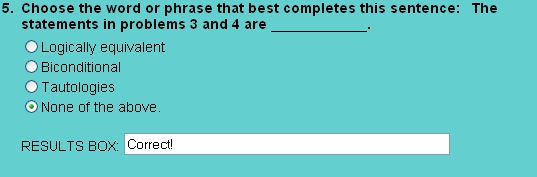
The statements in problems 3 and 4 do not have the same truth values. Therefore, they are not logically equivalent. These statements are conditional, not biconditional. Neither statement satisfies the definition of a tautology. Thus, the only logical choice is “None of the above.”
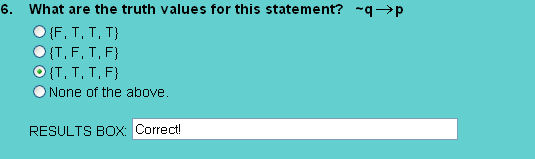
See the truth table below.
| p | q | ~q | ~qp |
| T | T | F | T |
| T | F | T | T |
| F | T | F | T |
| F | F | T | F |
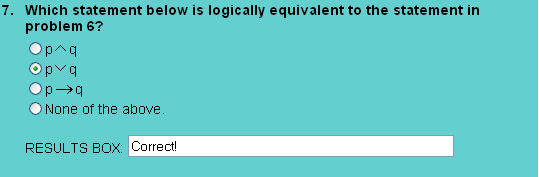
The disjunction of p and q is {T, T, T, F}. Therefore pq is logically equivalent to the conditional ~qp from problem 6.
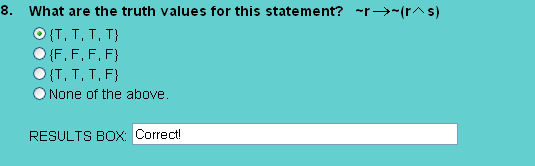
See the truth table below.
| r | s | ~r | rs |
~(rs) |
~r~(rs) |
| T | T | F | T | F | T |
| T | F | F | F | T | T |
| F | T | T | F | T | T |
| F | F | T | F | T | T |
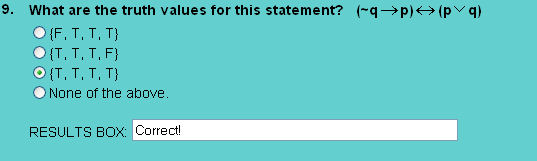
We know from problem 6 that the truth values of ~qp are {T, T, T, F}. In problem 7, we determined that pq is logically equivalent to ~qp. By definition, the biconditional of two equivalent statements is a tautology. Therefore, (~qp)(pq) is a tautology (see the truth table below).
| ~qp |
pq |
(~qp)(pq) |
| T | T | T |
| T | T | T |
| T | T | T |
| F | F | T |
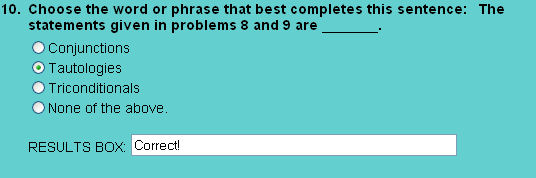
The truth values for each statement given in problems 9 and 10 are {T, T, T, T}. Therefore, these statements are tautologies.