Our math lessons are designed to make math meaningful to the student. They will guide learners through mathematical concepts, breaking down each step in a clear and understandable manner. They provide a structured approach to learning math, ensuring comprehensive understanding and proficiency. Each math lesson provides in-depth instruction ideal for learners of all ages and abilities. Choose a topic below to start your adventure.
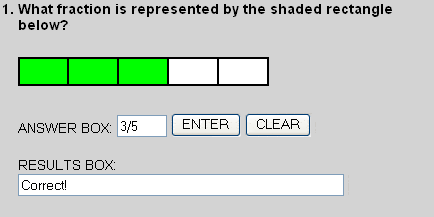
Solutions: Introduction to Fractions
Introduction to Fractions A fraction is the number of shaded parts, divided by the number of equal parts. There are 3 shaded parts and 5 equal parts in this rectangle, so the answer is three-fifths. There are 5 shaded parts and 8 equal parts in this circle, so the answer is five-eighths. Classifying Fractions A […]
Read More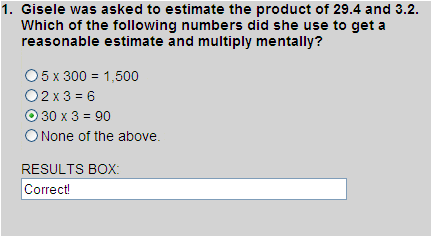
Solutions: Decimals, Part II
Estimating Decimal Products Using compatible numbers, 29.4 is changed to 30 and 3.2 is changed to 3. The product of 30 and 3 can be computed mentally. Rounding both factors down, we get: 05.7 05 34.3 30 The product of 5 and 30 is 150. Rounding both factors up, we get: 05.7 06 34.3 40 The product of 6 […]
Read More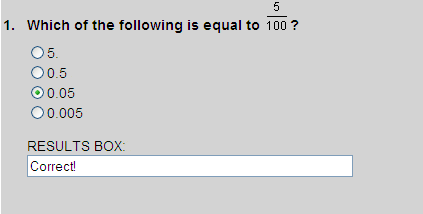
Solutions: Decimals, Part I
Introduction to Decimals is shown in the place-value chart below. 0 . 0 5 is shown in the place-value chart below. 0 . 2 3 1 Seven hundred sixty-two and three tenths is shown in the place-value chart below. 7 6 2 . 3 Expanded form is a way to write numbers […]
Read More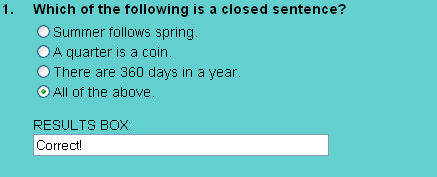
Solutions Volume 9: Symbolic Logic
Lesson on Sentences and Negation Each of these sentences is a closed sentence (an objective statement which is either true or false). “Jenny does not ride the bus” is the negation of “Jenny rides the bus.” The negation of p is “not p.” The statement ~x represents the negation of x. The statement ~a represents […]
Read More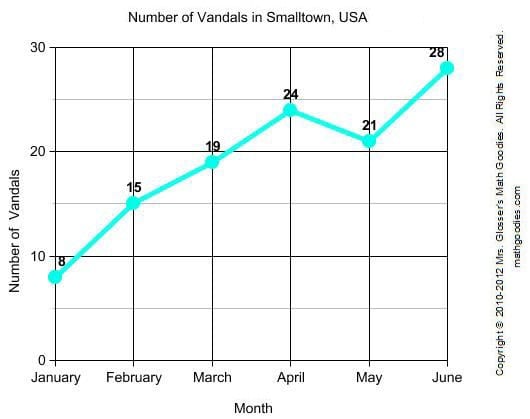
Solutions: Data and Graphs
Data and Line Graphs Exercise Problem Answer 1 In which month were there the most vandals? June 2 In which month were there the least vandals? January 3 How many vandals were there in March? 19 4 In which month were there 24 vandals? April 5 How many vandals were there in February? 15 […]
Read More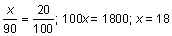
Solutions: Percent Applications
Percent and Proportions Exercise Problem Solution Answer 1 What is 20% of 90? 18 2 14 out of 56 students got an A. What percent got an A? 25% 3 There are 18 girls in a class. If this is 40% of the class list, then how many students are in the class? 45 4 […]
Read More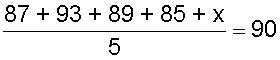
Solutions: Introduction to Statistics
Range Exercise Problem Solution 1 Find the range of these distances run by 6 marathon runners: 10 km, 15 km, 12 km, 14 km, 8 km, 16 km 8 km, 10 km, 12 km, 14 km, 15 km, 16 km 16 km – 8 km = 8 km 2 Find the range of these quiz […]
Read More
Solutions: Topics in Pre-Algebra
Order of Operations Exercise Problem Solution 1. 9 + 6 x (8 – 5) 9 + 6 x (8 – 5) = 9 + 6 x 3 = 9 + 18 = 27 2. (14 – 5) ÷ (9 – 6) (14 – 5) ÷ (9 – 6) = 9 ÷ (9 – 6) = […]
Read More
Solutions: Probability
Introduction to Probability Exercise Problem Solution 1 Which of the following is an experiment? Tossing a coin. Rolling a single 6-sided die. Choosing a marble from a jar. All of the above. All of the above. 2 Which of the following is an outcome? Rolling a pair of dice. Landing on red. Choosing 2 marbles […]
Read MoreSolutions: Integers
Introduction to Integers Exercise Problem Solution 1 Write an integer to represent the following situation: Earnings of 15 dollars +15 2 Write an integer to represent the following situation: A loss of 20 yards –20 3 What is the opposite of –231? +231 or 231 4 What is the opposite of +1096? (Do not enter a comma […]
Read More